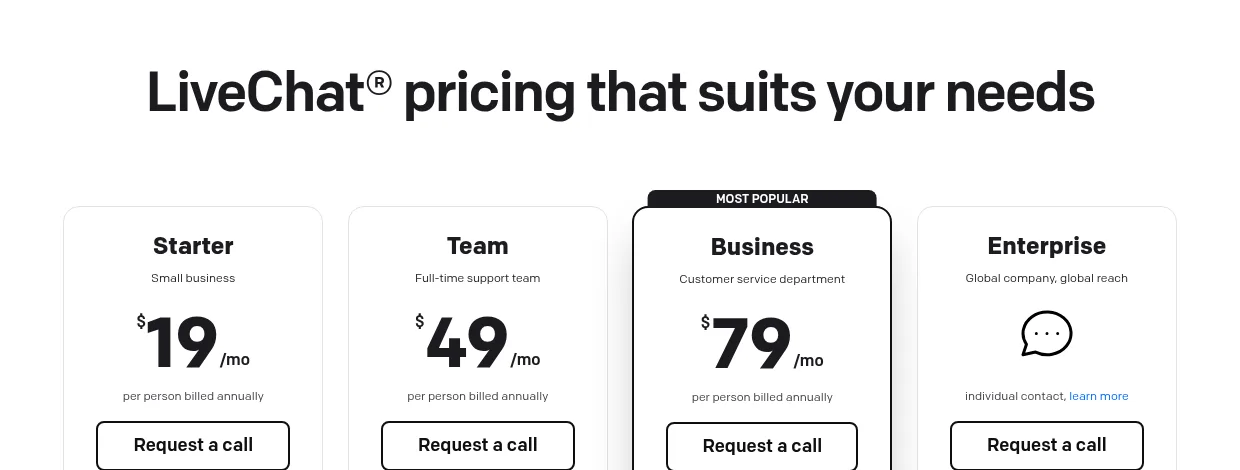
Before the full breakdown, the quick read. LiveChat earns its 4.5/4.6 review scores for staffed support and ecommerce teams, but per-agent pricing, a one-user Starter tier, and the rebrand to Text make it a poor fit for solos and confusing for new buyers. On pricing, the short version: No free plan; 14-day free trial, no credit card. Legacy LiveChat per-user/month billed annually: Starter $19 (1 user, 60-day history, 1 campaign), Team $49 (up to 400 users, unlimited history), Business $79 (most popular; work scheduler, staffing prediction, advanced reporting, SMS/Apple Messages), Enterprise custom (white label, SSO, HIPAA, SLAs). Monthly billing: $25/$59/$89. New trials now land on Text: Essential $19 annual ($25 monthly), Growth $79 annual ($99 monthly), Enterprise custom. Extra AI resolutions 50-pack $49.50; extra API calls 100k-pack $29.50. ChatBot and HelpDesk sold separately. The current overall score is 4.2/5. Every number here comes from the live site or aggregator-reported ratings, not a vendor deck, so you can decide in one read whether it is worth the trial.
A visitor lands on your pricing page, hesitates for 90 seconds, and leaves — and you’ll never know what almost made them buy. Live chat is supposed to catch that person at the exact moment they have a question, and LiveChat is one of the oldest and most established names in the category. I tested how it actually works for a small team, from the chat box to the reporting, to see whether it earns its price or just adds another tab nobody watches.
The Short Version
LiveChat is the name most people mean when they say “live chat software.” It has been around since 2002, powers the chat box on tens of thousands of websites, and scores around 4.5 on G2 and 4.6 on Capterra across a large combined review base. The product itself is genuinely mature: a clean agent app, a highly customizable widget, solid routing, proactive campaigns, and one of the deepest integration marketplaces in the category. The catch in 2026 is not the software. It is the billing and the rebrand. LiveChat charges per agent, which gets expensive fast for a small team, and the company has quietly moved new signups onto a successor product called Text while keeping the old LiveChat plans frozen for existing customers.
Here’s what I actually tested. I worked through the live pricing pages, the full plan comparison table, the feature matrix, and the vendor’s own reviews hub, and I cross-checked the ratings against independent review snapshots. I did not complete a trial signup in this environment, so this review is based on the live marketing site, the documented plan limits, and third-party user feedback rather than a logged-in build-out of a real chat. Where something depends on clicks inside the agent app, I’ve said so.
The short version: if you run a real support team that needs a battle-tested chat widget, proactive outreach, Shopify and Messenger channels, and reporting, LiveChat (or its successor Text) is a safe, well-supported choice. If you are a solo site owner or a two-person shop who just needs a “chat with us” box, the per-agent math will make you wince, and cheaper tools like Tidio or Crisp do the job at a fraction of the price. The other thing to know before you click through: the LiveChat you are about to sign up for today may actually be Text.
Who This Is For (and Who Should Skip)
Match yourself to the product before you pay.
- ✅ Ecommerce and support teams that live in chat If you already staff 3 to 20 agents, sell through Shopify or WooCommerce, and need routing, canned responses, supervision, and performance reporting, the Team or Business tier is exactly the workflow this tool was built for.
- ✅ Buyers who want a mature, deeply integrated widget The widget supports 48 languages, dark mode, WCAG 2.1 accessibility, right-to-left languages, and a live visual editor, and the marketplace connects to Messenger, SMS, WhatsApp, Instagram, and the usual CRM stack.
- ✅ Teams that already bought into the Text ecosystem If you also use ChatBot.com or HelpDesk.com, LiveChat shares the same parent company (Text S.A., formerly LiveChat Software S.A.) and the same account system, which makes the stack easier to run than stitching together four vendors.
- ❌ Solo operators and micro-sites on a budget Starter locks you to a single user, 100 tracked visitors, one campaign, and 60 days of history. For a one-person business, Tidio or Crisp give you a chat box plus a basic bot for less than half the per-agent price.
- ❌ Anyone who needs email ticketing or a full help desk out of the box The legacy LiveChat plans are chat-first. Native ticketing lives in the separate HelpDesk product, and serious AI automation lives in the separate ChatBot product. If you want one bill for everything, the new Text plans fold those in, but at a different (and for some teams higher) price.
Score Breakdown
What Actually Matters: Features, Reviewed
Here’s what the product actually does, with the line between what I verified on the live site and what I only read about kept visible.
💬 The chat widget and the agent app
This is the core product and it is the part that has aged well. The website widget is fully customizable with a live editor, supports 48 languages, dark mode, right-to-left layouts, screen-reader support, and a custom logo. On the agent side you get smart chat assignment, manual routing, routing rules by URL and geolocation, chat transfer, internal notes, canned responses, and the ability to take over a conversation from a bot or a teammate. Per the comparison table I pulled from the live pricing page, Starter gives you basic widget customization and one user; Team unlocks full widget customization, up to 400 users, and unlimited chat history; Business adds work scheduler, staffing prediction, and SMS plus Apple Messages for Business. The one thing that surprises people: Starter is hard-capped at a single user, so it is a trial-sized tier, not a home for a two-person team.
📝 Proactive outreach, ecommerce, and reporting
LiveChat was doing “proactive chat” before it was a buzzword. You set up recurring campaigns that greet visitors, one-time campaigns for announcements, and an eye-catcher to draw attention to the chat window. The ecommerce side is the reason a lot of stores buy it: native Shopify, WooCommerce, and BigCommerce integrations, live cart preview in chat, cart recovery campaigns, buying-intent detection, sales reports tied to chats, and a sales tracker. Reporting scales by tier: Starter and Team give you the dashboard and basic summaries, Business adds agent activity, agent performance, on-demand reports in CSV/TSV/XLS, and staffing prediction. The limits that bite are the visitor-tracking caps: 100 concurrent live visitors on Starter, 400 on Team, 1,000 on Business. If you run a high-traffic launch, you will notice that ceiling.
🔄 The rebrand: you may be signing up for Text, not LiveChat
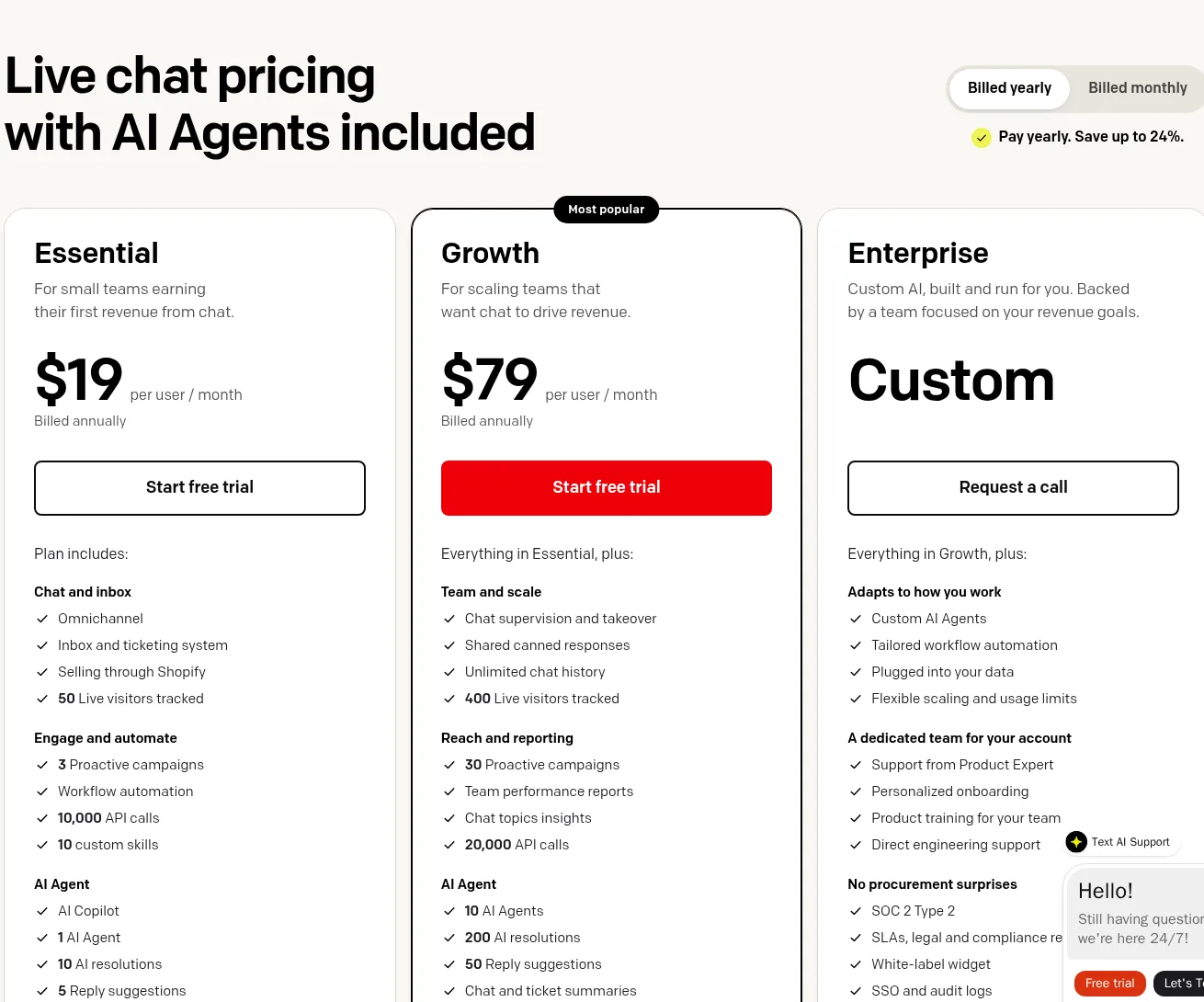
This is the single most important thing I found while researching, and it is buried three clicks deep. The current livechat.com/pricing page no longer sells the classic Starter/Team/Business/Enterprise lineup. It sells Text: Essential at $19 per user per month billed annually ($25 monthly), Growth at $79 ($99 monthly), and Enterprise custom. Text folds the chat, a shared inbox, ticketing, and an AI Agent with included AI resolutions into one subscription. The legacy LiveChat plans still exist (I verified them on the pricing-legacy page), but the pricing page itself says existing LiveChat accounts keep their plan and price, while new trials start on Text. Practically: if you click through today expecting the old four-tier LiveChat, you will land on Essential/Growth/Enterprise, and the feature mix is different. Anyone comparing this review against an older LiveChat roundup needs to know the two lineups are not the same product. One small detail that did carry over: the Text widget is now rated to WCAG 2.2 AA accessibility, while the legacy LiveChat widget carries the older WCAG 2.1 Level AA rating.
🤖 AI, ChatBot, and the ecosystem bills
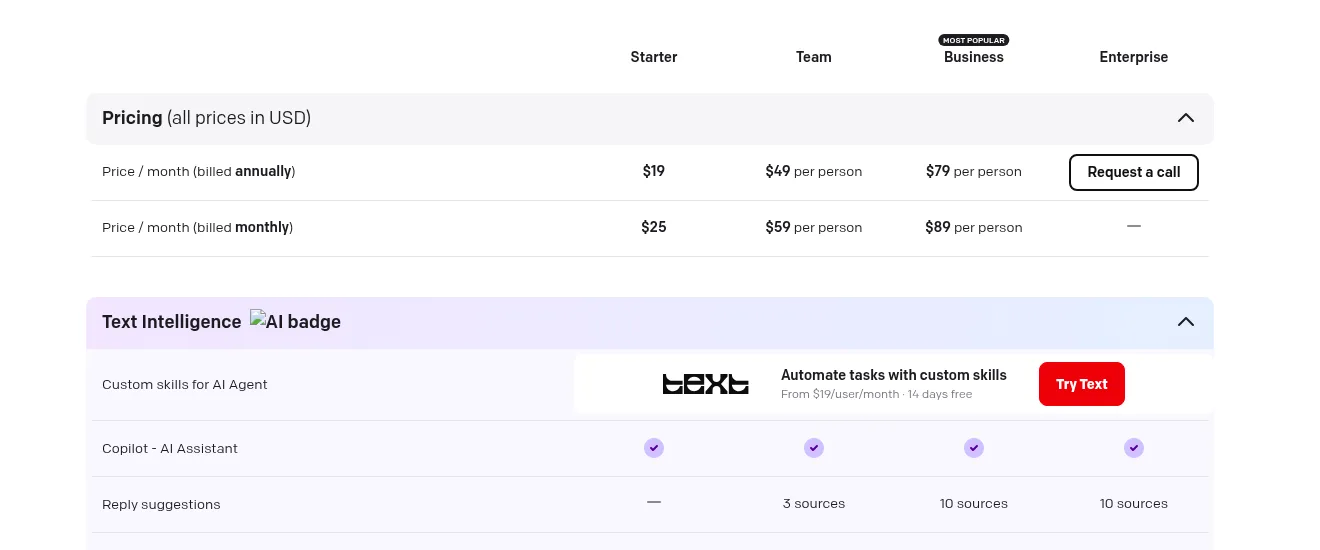
Every legacy plan now ships Text Intelligence: an AI Copilot, reply suggestions (3 knowledge sources on Starter, 10 on Team, Business and Enterprise), tag suggestions, and chat summaries from Business upward. But that is assistive AI for your agents. If you want a bot that handles conversations on its own after hours, that is ChatBot.com, a separate paid product. If you want email ticketing and a help-desk queue, that is HelpDesk.com, also separate (it starts at $29 per month per the live comparison page). The new Text plans are the company’s answer to this fragmentation: one subscription that bundles chat, tickets, and an AI Agent. The practical read: on the legacy line, budget for the add-ons or you will outgrow Starter within a year; on Text, you get the bundle but the headline price assumes you need the AI allowances.
What Real Users Actually Say
LiveChat has one of the largest review footprints in the live-chat category. Here is what I found.
The Aggregate Scores
On its own reviews hub, LiveChat reports a 4.6 out of 5 across 1,600-plus positive reviews and cites 30,000-plus customers and more than 75 million monthly chats. Independent 2026 snapshots agree on the shape of the score: G2 sits at about 4.5 out of 5 from a large review base, and Capterra at about 4.6 out of 5 from a similarly large review base. The pattern across both platforms is consistent: reviewers praise the ease of setup, the responsiveness of the support team, the look of the widget, and the reliability of the chat itself.
— LiveChat reviews hub, plus independent 2026 snapshots of G2 and Capterra, cross-checked October 2026; the G2 and Capterra pages themselves blocked automated access, so figures are vendor- and third-party-reported rather than pulled live
The Recurring Criticism
The negative pattern clusters around money, not software. First, per-agent billing: every user account costs money whether it logs in or not, and reviewers consistently note that the bill scales steeply as you add seats, which is why smaller stores often leave for Tidio or Crisp. Second, gating: Starter is deliberately thin (one user, 60-day history, one campaign), so users who sign up on the cheapest tier and assume the platform is included feel shortchanged. Third, add-ons: serious automation means paying for ChatBot, ticketing means paying for HelpDesk, and some channels are marketplace apps with their own fees, so the headline per-agent price understates the real monthly cost. Fourth, expectations: as the rebrand to Text rolls out, some long-time users report confusion about which product and which price they are actually on.
— G2 and Capterra review patterns as summarized in independent 2026 live-chat roundups, plus the vendor FAQ, October 2026
Read the scores correctly. A 4.5/4.6 across 2,500-plus reviews is a genuinely mature product rating, not a new-vendor honeymoon. But the score is carried by the product experience, not the deal: the recurring complaints are all about billing structure and tier gating, which tells you LiveChat is worth buying if you size the tier honestly and not worth buying if you hope Starter will carry a team.
User feedback sourced from G2 and Capterra reviews.
Pricing: Every Plan, Laid Bare
There is no free plan. You get a 14-day free trial with no credit card required, then pick a paid tier. One important caveat first: new trials at livechat.com now land on Text plans, not the legacy LiveChat lineup. The legacy Starter/Team/Business prices below are what existing LiveChat customers pay and what the pricing-legacy page lists today; Text Essential and Growth are the equivalent entry and mid tiers for new buyers. Prices are per user (agent) per month, all in USD, before tax.
| Plan | Price (per person, per month) | What You Get |
|---|---|---|
| Starter (legacy) | $19 annual / $25 monthly | 1 user only, up to 100 live visitors tracked, 1 recurring campaign, 60-day chat history, basic widget customization, canned responses, 24/7 support, AI Copilot with 3 reply-suggestion sources. No unlimited users, no unlimited history. |
| Team (legacy) | $49 annual / $59 monthly | Up to 400 users, 400 live visitors, unlimited campaigns, unlimited chat history, full widget customization, basic reporting, team performance basics, 10 knowledge sources for reply suggestions, routing rules, canned responses, internal notes. |
| Business (legacy, most popular) | $79 annual / $89 monthly | Up to 1,000 live visitors, work scheduler, staffing prediction, on-demand reporting, advanced and agent-performance reports, chat summaries, SMS and Apple Messages for Business, multilingual routing by language. |
| Enterprise (legacy) | Custom | Everything on Business, plus white-label widget, SSO, audit logs, HIPAA compliance, SLAs, dedicated onboarding, product-expert support, custom visitor limits, and flexible user count. |
| Text Essential (new trials) | $19 annual / $25 monthly | For new signups: live chat plus shared inbox and ticketing, 1 AI Agent with 10 AI resolutions/month, 50 live visitors, 3 proactive campaigns, 10,000 API calls, Shopify selling, 60-day history. |
| Text Growth (new trials, most popular) | $79 annual / $99 monthly | Everything in Essential, plus chat supervision and takeover, unlimited chat history, 400 live visitors, 30 campaigns, team performance reports, 10 AI Agents with 200 AI resolutions/month, 20,000 API calls, chat and ticket summaries. |
| Text Enterprise | Custom | Custom AI Agents, tailored workflows, flexible usage limits, dedicated team and onboarding, SOC 2 Type 2, SLAs, white-label widget, SSO and audit logs. |
A few honest caveats. You pay for every user account, whether that person ever logs in, so headcount directly equals cost: three agents on Team is $147/month billed annually, five on Business is $395/month before tax. Extra AI resolutions on Text come in packs of 50 for $49.50, and extra API calls in packs of 100,000 for $29.50. ChatBot, HelpDesk, and several marketplace channels are separate subscriptions. If you are comparing this to a cheaper widget for a small store, lighter tools like Tidio or Crisp cost less per seat, at the cost of a thinner marketplace and less mature routing and reporting.
The Unfiltered Pros & Cons
Pros
- ✓ A genuinely mature chat product with a highly customizable 48-language widget, smart routing, takeover, supervision, and proactive campaigns
- ✓ One of the deepest integration marketplaces in the category: Shopify, WooCommerce, BigCommerce, Messenger, SMS, WhatsApp, Instagram, plus API and Zapier
- ✓ 4.5 on G2 and 4.6 on Capterra across roughly 2,500 combined reviews, with support quality repeatedly singled out
- ✓ 24/7/365 support included on every tier, a 14-day trial with no credit card, and annual billing that cuts the per-agent price by roughly 20 to 24% on the new Text plans
- ✓ The new Text plans fold chat, ticketing, and an AI Agent into one bill, which fixes the old fragmentation
Cons
- ✗ Per-agent billing is expensive for small teams: every account costs money, and five agents on Business is nearly $400/month before tax
- ✗ Starter is locked to a single user with 60-day history and one campaign, so it is a taster tier rather than a home
- ✗ Ticketing means HelpDesk, real AI automation means ChatBot, and some channels are marketplace add-ons with their own fees
- ✗ The rebrand to Text means new signups no longer get the classic LiveChat lineup, and the two pricing structures are confusing to compare
- ✗ I did not run a live chat inside the product in this environment, so in-app UX is assessed from documentation, the feature matrix, and user reports
Final Verdict
LiveChat earns its reputation. For a real support or ecommerce team, the widget, routing, reporting, and integration depth are hard to beat, and the 4.5/4.6 scores across thousands of reviews are earned. What keeps it from a higher score is the business model: per-agent pricing that hurts small teams, a Starter tier capped at one user, and a rebrand that makes it unclear whether you are buying LiveChat or Text. Buy it if you staff more than a couple of agents; buy Tidio or Crisp if you do not.
If you are evaluating it today, start the 14-day trial and watch carefully which product you land on. If you are a staffed team that wants chat plus ticketing plus an AI Agent in one bill, Text Growth is the tier to trial, because that is where supervision, unlimited history, and the 10 AI Agents actually live. If you are an existing LiveChat customer, nothing changes about your plan or your price, so you can sit tight while evaluating whether to migrate.
If you are a solo site or a two-person shop, do not force this. Run the numbers: LiveChat Starter at $19 per month gets you one user and 60 days of history, while lighter tools cover the same widget-plus-bot job at a lower all-in cost. You can read more about how we evaluate tools and why you can trust our reviews on our methodology page. We are reader-supported and may earn a commission when you buy through our links; see our affiliate disclosure.
Frequently Asked Questions
Is LiveChat free?
There is no permanently free plan. LiveChat offers a 14-day free trial with no credit card required; after that you choose a paid tier. Legacy LiveChat plans start at $19 per user per month billed annually on Starter, and the new Text lineup starts at the same $19 on Essential.
How much does LiveChat cost in 2026?
Legacy LiveChat plans are billed annually at $19 per user on Starter (one user), $49 on Team, and $79 on Business; Enterprise is a custom quote. Monthly billing runs $25, $59, and $89 per user respectively. New trials now land on Text: Essential at $19 per user monthly and Growth at $79, both billed annually. Every user account costs money whether it logs in or not.
Is LiveChat worth it for a small business?
For a staffed support or ecommerce team, usually yes: the widget, routing, reporting, and integrations are mature and the reviews back that up. For a solo operator or a two-person shop, the per-agent math is steep and Starter is capped at one user, so Tidio or Crisp will often be the better value. Also factor in that ticketing and AI automation are separate products unless you are on the new Text plans.
What is the difference between LiveChat and Text?
They are made by the same company, Text S.A. (formerly LiveChat Software S.A.). LiveChat is the legacy chat-first product with Starter, Team, Business, and Enterprise plans. Text is the current product for new signups, bundling live chat, a shared inbox, ticketing, and an AI Agent into Essential ($19) and Growth ($79) plans. Existing LiveChat customers keep their old plan and price; new trials start on Text.
About the Author