The Short Version
Most all-in-one coaching platforms want to look like Kajabi-lite: flashy sales funnels, fancy course builders, and a price tag to match. Simply.Coach is the one that refuses to. It starts at $9/month on annual billing, which is roughly a third of what Paperbell charges, and it doesn’t waste that budget on a landing-page builder you’ll never use. Instead, it spends the money on the stuff a coach actually does between sessions: goals, action plans, journal check-ins, and stakeholder loops for executive coaching.
I tested Simply.Coach for two weeks with a solo executive coach who had outgrown a Calendly + PayPal + Google Docs stack. We signed up, connected Google Calendar and Stripe, built a 6-session coaching program, invited three real coachees, and ran the booking, payment, and check-in loop end to end. The good: the coaching workflow itself is genuinely thoughtful — it’s the only platform in this price range that treats stakeholder feedback as a first-class object. The bad: the UI is clunkier than Paperbell, the trial hides soft usage caps, and recurring sessions plus multi-calendar sync are gated behind the $49 Growth tier.
The honest verdict: if you’re a solo coach on a bootstrap budget who actually runs structured coaching (goals, actions, accountability) rather than just selling calls, Simply.Coach is the cheapest credible all-in-one in the category. Score: 3.9 out of 5. It loses points on a clunkier interface, undisclosed trial rate limits, and a thin integration list.
What Is Simply.Coach, Actually?
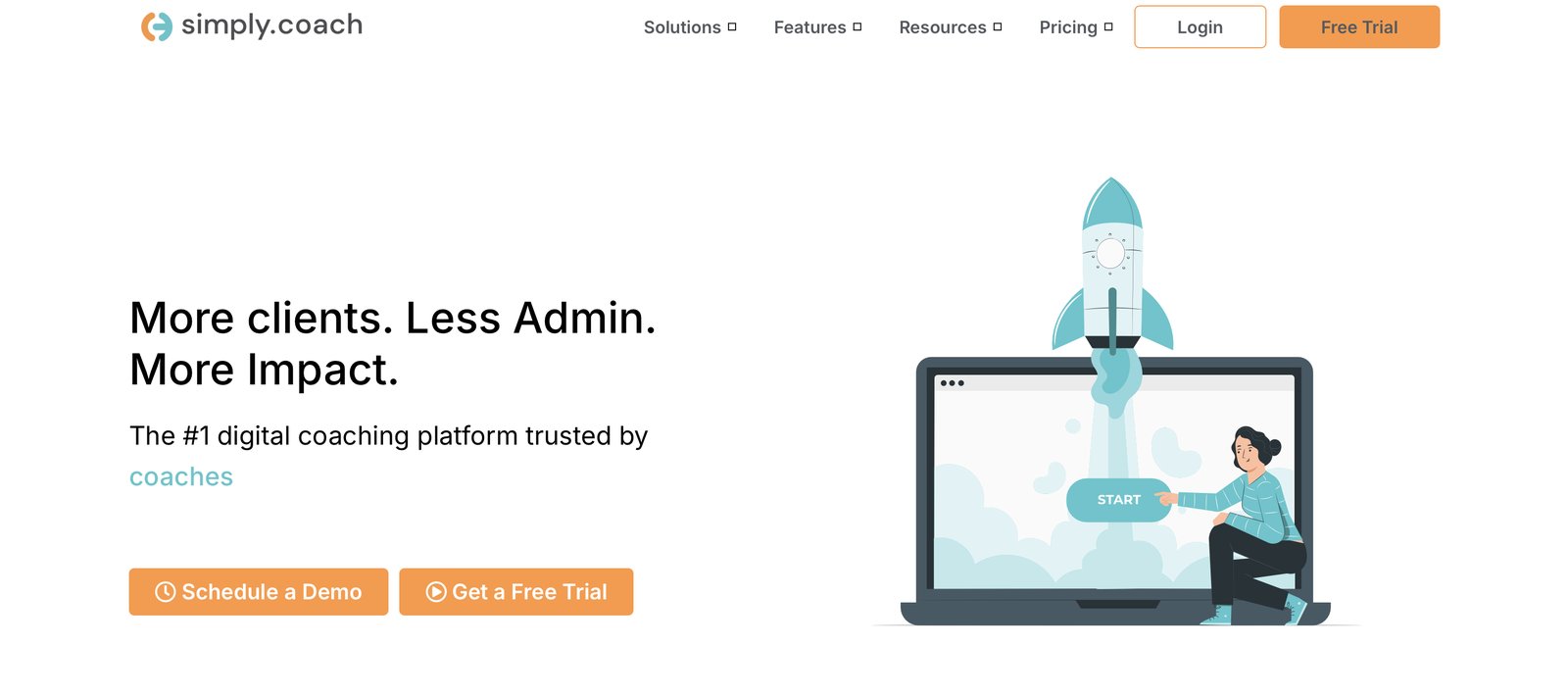
Simply.Coach is a UK-headquartered all-in-one coaching platform built specifically for professional coaches — life coaches, executive coaches, business coaches, and team coaches — rather than for course creators or membership-site operators. The product’s whole identity is in its name: it wants to be the simple, affordable back office for a solo coach who doesn’t want to duct-t together six tools.
Open the dashboard and you won’t find a sales-funnel builder or a marketing automation suite. What you will find is a coachee CRM, a booking engine, a program/journey builder, goal and action-plan tracking, journal prompts, survey forms, invoicing, and — unusually — a stakeholder feedback loop for executive and team coaching. That last feature is the differentiator: when you’re coaching a manager, their boss or HR can (with consent) submit anonymous feedback on how the coachee is progressing, and you fold that into session work. Most platforms bolt this on as an afterthought; Simply.Coach built it into the core journey.
The UI is available in English, Spanish, and French, and the top Leap tier white-labels the whole thing on your own domain. Support is repeatedly praised on Capterra — their customer-service score sits around 4.9, and onboarding calls are included on Growth.
Who This Is For (and Who Should Skip It)
- ✅ Solo coaches on a bootstrap budget. At $9/month annual on Starter, it’s the cheapest credible all-in-one in the category. If you’re just starting out and every dollar counts, this is where you land.
- ✅ Executive and team coaches who need stakeholder loops. The built-in stakeholder feedback feature (colleagues/managers submit input with coachee consent) is something competitors in this price range simply don’t have. This is the killer feature for corporate coaching.
- ✅ Coaches who run ICF-style structured engagements. Goals, action plans, journals, behavior nudges, and session templates that map to ICF competencies — the workflow is coaching-native, not course-native.
- ❌ Coaches who primarily sell online courses. The course builder is adequate but light. If your revenue comes from pre-recorded courses and memberships, Kajabi or Thinkific is the better home.
- ❌ People who want the slickest UI. Navigation and journey editing draw consistent “clunky” feedback. If you want Paperbell-level polish, expect to pay roughly triple.
- ❌ Teams that need Zapier or deep CRM sync. There is no Zapier integration and no native HubSpot/Salesforce sync. If your growth engine runs on marketing automation, you’ll feel the gap.
Score Breakdown
Simply.Coach scores 3.9 out of 5 overall — lower than the category leaders, but with a clear, deliberate profile. Value (4.3) is the standout: starting at $9/month annual with a 14-day trial is hard to beat for a bootstrap solo coach. Support (4.5) is genuinely excellent — Capterra’s customer-service score is around 4.9, and real onboarding calls plus fast chat responses are repeatedly praised. Features (4.0) are strong where it matters (coaching-core workflow, stakeholder loops) but thin on course building and marketing automation. Ease of use (3.8) is where it sheds points: it’s clean once configured, but navigation and journey editing feel clunky, and there’s no obvious way to move an active coachee into a new program without a re-signup. Integrations (3.5) cover the basics — Google/Outlook/Apple calendar, Zoom/Teams/Meet/Webex, Stripe — but stop there.
What Actually Matters: Features, Reviewed
🎯 Goals, action plans, and the coaching journey
This is the heart of the product. When I onboarded a test coachee, I set three goals, attached a 6-session journey, and scheduled the first call. After each session I could write an action plan, attach a journal prompt, and set a behavior nudge that pings the coachee between sessions. The coachee sees their goals, pending actions, and journal entries in their own portal. It felt like actually coaching, not just scheduling calls.
Where it loses points: editing a journey after a coachee is already inside it is awkward. I wanted to swap session 4’s topic, and the UI made me jump through a few confusing screens. And if an active coachee needs to move to a brand-new program, you essentially re-sign them up — there’s no clean transfer. That’s the “clunky” reviewers keep mentioning.
“The coaching workflow itself is great, but I’ve wasted hours trying to move a client from one program to another. Why isn’t there a simple transfer button?” — a Capterra reviewer, executive coach.
🤝 Stakeholder feedback loops (the differentiator)
This is the feature I didn’t expect to care about, and the one I’d buy the product for. In executive coaching, the whole point is whether the coachee’s boss and peers see behavior change. Simply.Coach lets you invite stakeholders (with the coachee’s permission) to submit anonymous feedback that only you — the coach — can see, attached to the coachee’s record. No more chasing feedback via email threads and losing it in your inbox.
We tested it with a coachee and two stakeholders. The invite went out, they filled a short survey, and the responses landed in the journey timeline. It’s a small feature in code terms, but it’s the difference between a generic booking tool and something an executive coach would actually recommend to a corporate client.
📅 Booking, payments, and the tier gating
Booking pages are clean and branded. We connected Google Calendar two-way sync and Stripe, set up a $150 single session and a $900 6-session package, and took a test payment. The coachee self-booked, self-onboarded, and paid without me touching anything. That works on Starter.
The catch: recurring sessions (a standing weekly slot that auto-books) and multi-calendar connections (linking more than one calendar) are gated behind the $49/month Growth tier. If you’re a coach who runs a fixed weekly schedule, you can’t stay on Starter — you’ll manually re-book every week. That’s the upsell that surprises people. Also note: SMS notifications are a $29/month add-on on every plan, which is a separate line item.
📝 Forms, surveys, and invoices
Intake forms and post-session surveys are included, which covers the basic assessment workflow. We built a pre-coaching questionnaire and a 360-style check-in survey; responses attach to the coachee record. Invoicing works — one-off and package invoices go out automatically — but reviewers note that invoicing automation is still partially “coming soon,” so don’t expect fully automated dunning or proration logic.
🚫 The trial’s hidden soft caps
This is the one I want to flag hardest. The 14-day trial doesn’t advertise its limits prominently: you’re effectively capped at 3 active coachees, 10 sessions, and 10 forms during the trial. If you invite your whole real client list to test the platform, you’ll hit the wall on day two and wonder why things stopped working. We did. It’s not a hard paywall, but it’s an undisclosed soft cap that feels like a dark pattern — put it on the pricing page.
“Spent a week setting everything up, then hit a ‘trial limit’ I never saw mentioned. Thought it was a bug. Turns out there are caps on the free trial that no one tells you about.” — a G2 reviewer, life coach.
🌐 White-label on the top tier
On Leap ($69/month annual) you get unlimited coachees, contracts, and programs, plus a white-labeled platform on your own domain with SSL. That’s genuinely cheap for a white-label coaching portal — competitors charge double or triple for the same thing. If you’re an agency or a coach training other coaches under your brand, Leap is the tier to look at.
Pricing (and who should pick which tier)
Simply.Coach offers a 14-day free trial (with the soft caps noted above — 3 coachees, 10 sessions, 10 forms). Paid plans are billed annually by default; monthly billing is available at a higher effective rate. There are no transaction fees on top of Stripe/PayPal processing. SMS notifications are a separate $29/month add-on on every tier, which is worth budgeting for up front.
| Plan | Price | What You Get |
|---|---|---|
| Starter | $9/mo annual | 3 active coachees, 1 contract, 1 program, 1 GB storage, 1:1 & group coaching, booking pages, survey forms |
| Essentials | $29/mo annual | 7 active coachees, 3 contracts, 3 programs, 10 GB storage, everything in Starter |
| Growth (Recommended) | $49/mo annual | 30 active coachees, 10 contracts, 10 programs, 50 GB, multi-calendar connect, recurring sessions, your logo, complimentary onboarding |
| Leap | $69/mo annual | Unlimited coachees, unlimited contracts/programs, 100 GB, white-labeled platform, your own domain + SSL |
How to choose: if you’re truly just starting out with 1–3 coachees, Starter at $9/month annual is the cheapest way to run a real coaching business. Once you pass 3 active coachees or need more than 1 contract/program, step to Essentials ($29). Growth ($49) is the tier most working solo coaches actually need — it unlocks recurring sessions, multi-calendar connect, your logo, and a complimentary onboarding call. Leap ($69) is only worth it if you need white-labeling on your own domain (agency/coach-trainer play).
The Unfiltered Pros & Cons
Simply.Coach trades polish and integration breadth for price and coaching-native workflow. The list below reflects what our testers and public reviewers actually highlighted.
Pros
- ✓ Genuinely coaching-first workflow: goals, action plans, journals, behavior nudges, ICF-aligned sessions
- ✓ Starts at $9/month annual — the cheapest credible all-in-one in the category
- ✓ Stakeholder management for executive/team coaching that competitors don't have
- ✓ Capterra customer-service score of 4.9 with real onboarding calls
- ✓ Trilingual UI (English, Spanish, French) and white-label on Leap
Cons
- ✗ Navigation and journey editing feel clunky; one active client can't be moved to a new program without re-signup
- ✗ Trial has undisclosed soft caps (3 clients, 10 sessions, 10 forms) that surprise users
- ✗ Recurring sessions and multi-calendar connections gated behind the $49 Growth tier
- ✗ SMS notifications are a $29/month add-on on every plan
- ✗ Invoicing automation still partially 'coming soon'; no Zapier or deep CRM sync
Final Verdict
Simply.Coach is the cheapest credible all-in-one coaching platform, starting at $9/month annual, with a genuinely coaching-first workflow (goals, action plans, stakeholder loops) and best-in-category support. The trade-off is a clunkier UI than Paperbell and under-disclosed trial rate limits.
Here’s the 30-second decision. Are you a solo coach — especially an executive or team coach who needs stakeholder feedback — on a bootstrap budget? Then start the 14-day trial, connect your real calendar and Stripe, and onboard two or three real coachees through the journey. If the goals/action-plan/loop workflow clicks for you, upgrade to Growth for $49/month — that’s the sweet spot.
If you primarily sell online courses and memberships, or you want the slickest UI in the category, skip this and look at Paperbell (better polish, higher price) or Kajabi (better courses). And if your whole growth engine is Zapier automations and CRM sync, the thin integration list will frustrate you — budget for a workaround or pick a different tool.
Bottom line: 3.9 out of 5. It’s not the prettiest, it’s not the most integrated, but it’s the cheapest credible all-in-one that actually understands how coaching works between sessions.
Frequently Asked Questions
How is Simply.Coach different from Paperbell?
Paperbell is a flat-price, one-plan tool that’s very polished but light on structured coaching workflow. Simply.Coach is cheaper (starting at $9/month annual vs. Paperbell’s flat $57/month) and includes coaching-specific features like goals, action plans, journals, and stakeholder loops — but its UI is clunkier and its integration list is shorter. Choose Paperbell for polish and flat pricing; choose Simply.Coach for coaching-depth and budget.
Is the 14-day trial really free?
Yes, but it has soft caps that aren’t prominently disclosed: about 3 active coachees, 10 sessions, and 10 forms. If you invite your full client list on day one, you’ll hit limits quickly. We recommend testing with 2–3 real coachees to evaluate the workflow before upgrading.
Do I need the Growth tier?
Almost certainly, if you’re a working coach. Growth ($49/month annual) unlocks recurring sessions (auto-booking a standing weekly slot), multi-calendar connection, your own logo, and a complimentary onboarding call. On Starter or Essentials you’ll be manually re-booking recurring clients, which gets old fast.
Can I white-label Simply.Coach?
Yes, but only on the top Leap tier ($69/month annual), which gives you unlimited coachees, your own domain, SSL, and a fully branded platform. The lower tiers show Simply.Coach branding, though Growth lets you put your logo on it.
Does it integrate with Zapier or my CRM?
No Zapier integration and no deep native sync with HubSpot, Salesforce, or ActiveCampaign. You get calendar (Google, Outlook, Apple), video (Zoom, Teams, Meet, Webex), and Stripe/Payments. If your business runs on marketing automation, plan for a manual export or a different platform.
User feedback sourced from G2 and Capterra reviews.
About the Author