The Short Version
Elai sits in the middle of the AI avatar pack. It isn’t the most photorealistic option on the market, and it isn’t the cheapest either. What it is, is unusually practical for training and onboarding: paste a script or import a slide deck, pick a presenter, add a quiz, and export something an LMS can actually consume.
Over three weeks we built a set of training videos from scripts, converted a PowerPoint into a narrated explainer, tested the article-to-video flow, and rendered the same script in several languages. The assembly line is smooth and fast, and the PPTX import is genuinely useful. The disappointment is the people on screen. On a small embed the avatars are fine; on a full-screen, close-up shot, the expressions feel stiff and the mouth work lags behind the leaders in this category.
If you’re producing internal training, compliance clips, or onboarding videos where the avatar is a presenter rather than the star, Elai earns a look. If your whole pitch depends on a lifelike digital human delivering a marketing spot, you’ll likely want to spend more elsewhere.
Who This Is For (and Who Should Skip)
Elai’s strengths and weaknesses point to a fairly specific user.
- ✅ L&D and training teams SCORM export, branching scenarios, built-in quizzes, and analytics make Elai a natural fit for compliance and onboarding content.
- ✅ Teams converting slide decks to video The PPTX-to-video flow reads speaker notes as the script, which saves an enormous amount of rebuilding.
- ✅ Multilingual content on a budget 75-plus languages and automatic translation let you localize a training library without re-recording.
- ❌ Anyone who needs lifelike presenters On close-ups and large screens, Elai’s avatars trail Synthesia and HeyGen on expressiveness and lip-sync.
- ❌ Heavy per-month producers The Creator plan’s 15 minutes runs out fast; the jump to Team is a steep per-seat increase.
Score Breakdown
What Actually Matters: Features, Reviewed
Elai packs a lot into a modest editor. Four features determine whether it’s the right tool for your videos.
📊 Slide and PPTX-to-video conversion
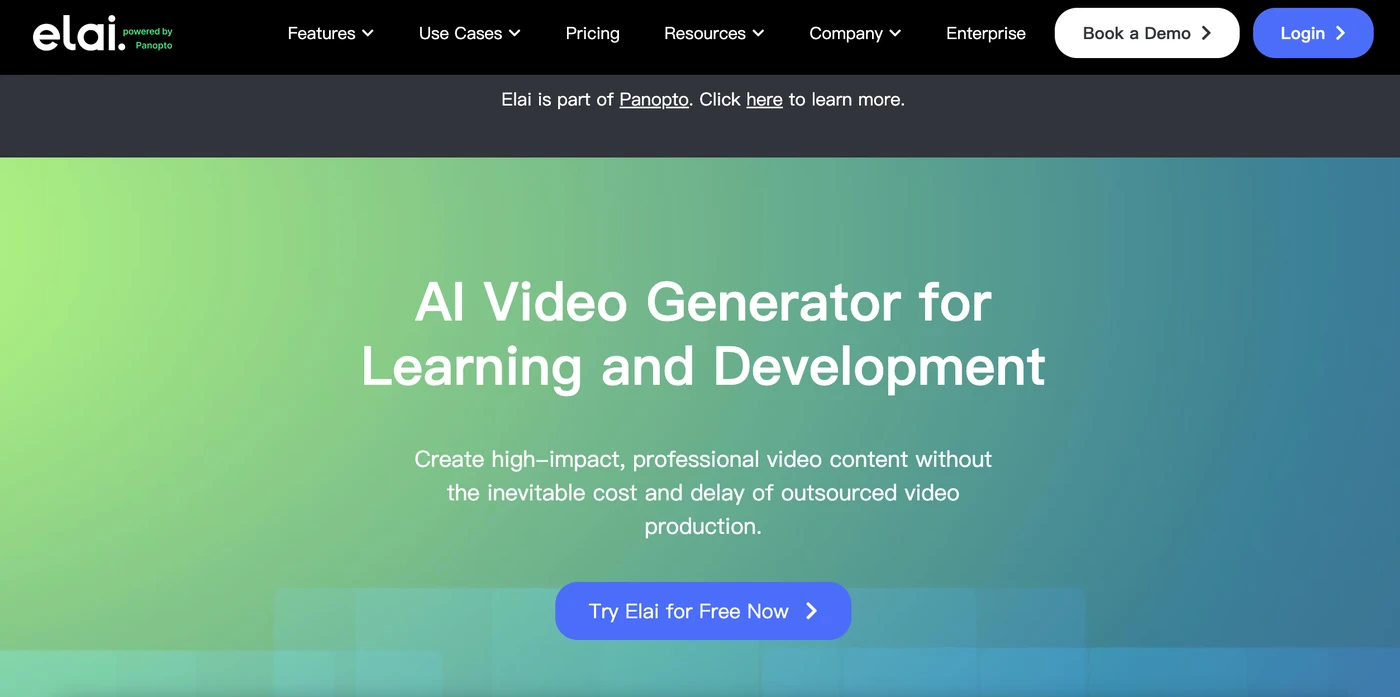
This is Elai’s best trick. Upload a presentation and Elai lays each slide onto a scene, then reads the speaker notes as the avatar’s script. We turned a twelve-slide onboarding deck into a narrated video in about ten minutes, which would otherwise mean booking a presenter and an editor. The layout doesn’t always perfectly match your master slide, and you’ll want to tidy text overflow, but the time saved is real for teams who already live in PowerPoint.
🎥 AI avatars and voice cloning
The library of 80-plus stock avatars is genuinely diverse across ages, genders, and ethnicities, which matters for global training content. Standard voices cover 75-plus languages. The limitation is realism: avatars look comfortable in medium shots but go stiff in close-up, and lip-sync can drift out of alignment on longer sentences. A selfie avatar and voice clone are available, but as add-ons they’re priced at roughly $199 and $200 a year on top of your plan.
🎓 Interactive video: quizzes, branching, hotspots
For e-learning this is where Elai pulls ahead of plain text-to-video tools. You can drop in text or image quizzes, add clickable buttons and hotspots, and build branching paths so different viewers follow different tracks. Combined with video analytics on watch time and engagement, it’s a compact little learning system. It’s less impressive for marketing videos, where these elements mostly feel like clutter.
🌐 Translation, localization, and SCORM export
One-click translation generates multilingual versions of a video, and SCORM export means finished content drops straight into an LMS. That pair makes Elai unusually well suited to a company that needs to roll the same compliance training out across several regions. The catch is quality assurance: translation is automated, so expect to review awkward phrasing, and some voices mispronounce niche terms in certain languages.
What Real Users Actually Say
We looked at Elai’s published customer feedback and the recurring G2 and Capterra themes. The praise centers on ease and the slide-to-video workflow; the criticism centers on the avatars.
The Good
“I like that video creation is super easy with Elai. I was creating videos for different kind of activities, mainly for email marketing and leadgen campaigns…”
— Solomiya M., Lead Generation Manager, Elai customer testimonial
“Elai.io’s ability to generate high-quality videos from text or URL inputs is impressive. I especially find the PPTX to video useful, with the option of the note section under the slide becoming the avatar’s speech text.”
— Sam Nicolas M., Lead Generation Manager, Elai customer testimonial
The Complaints
Recurring G2 and Capterra criticism: the avatars read as rigid and a little emotionless on close-ups, and lip-sync can drift out of alignment on longer passages, which is enough to break the illusion when the video is viewed on a large screen.
— Summary of recurring complaint themes on G2 and Capterra
Reviewers also note that some voices mispronounce certain words in certain languages, and that the 15-minute Creator allowance is tight: a single ten-minute training clip uses two-thirds of the month, leaving little room to revise and re-render.
— Summary of recurring complaint themes on G2 and Capterra
User feedback sourced from G2 and Capterra reviews.
Pricing: Every Plan, Laid Bare
Elai sells a fixed monthly minute allowance, not per-seat editing like VEED. Extra minutes are a flat $2 top-up. The entry plan is affordable, but the jump to Team is significant. Here’s the full ladder as listed on Elai’s pricing page (annual prices shown per month).
| Plan | Price | What You Get |
|---|---|---|
| Free | $0 | 1 user, 1 minute/month, 80+ avatars, 75+ languages, all Creator features, but Elai watermark and no Full HD export. For testing only. |
| Creator | $29/mo monthly, $23/mo annual ($276/yr) | 1 user, 15 minutes/month, Full HD 1080p, full avatar, voice and language library, 100+ templates, auto-captions, URL-to-video, public API. Roughly $1.53/minute annual. |
| Team | $125/mo monthly, $100/mo annual ($1,200/yr) | 3 editors plus 3 guests, 50 minutes/month (100 or 150 options), Ultra 4K, 100+ premium voices, custom images and fonts, 1 selfie avatar and 1 voice clone included (annual), brand kit, analytics. |
| Enterprise | Custom | Unlimited users, 3 voice clones, 3 selfie avatars, premium avatars, brand kit, workspaces, SSO, SCORM export, Panopto integration, SOC 2, premium support, unlimited minutes. |
The math to watch: Creator’s 15 minutes means a ten-minute training video consumes two-thirds of your month, and every re-render after an edit costs more minutes even if you don’t delete the old one. A one-minute top-up is $2, so a month of revisions can quietly add up. For individuals and small L&D tests, Creator at $276/year is reasonable. Once you need 4K, premium voices, or multiple editors, Team at $100/month annual is the realistic next step, and it’s a steep jump from $23. Skip the Free plan for anything real; it’s a one-minute watermarked demo.
The Unfiltered Pros & Cons
Pros
- ✓ PPTX and slide-to-video conversion that reads speaker notes as the script
- ✓ Interactive quizzes, branching, and hotspots built for e-learning
- ✓ SCORM export and analytics fit straight into a corporate LMS
- ✓ 80-plus diverse avatars and 75-plus languages for global training
- ✓ Competitive $1.53 per minute on the annual Creator plan
Cons
- ✗ Avatars look stiff on close-ups and lip-sync drifts on longer lines
- ✗ 15-minute Creator allowance burns fast, with re-renders costing more
- ✗ Selfie avatar and voice clone are expensive annual add-ons
- ✗ Some voices mispronounce terms in certain languages
- ✗ Editing surface is shallow; no fine motion control
Final Verdict
Elai is a workmanlike text-to-avatar video generator that turns scripts, slide decks, and URLs into presenter videos in minutes. The slide-to-video workflow, interactive quizzes, and SCORM export make it a smart pick for L&D teams. But the avatars read as rigid on close-ups, lip-sync drifts on longer passages, and the 15-minute entry allowance is tight.
For learning and development, Elai punches above its weight. The slide import, interactive quizzes, translation, and SCORM export are the details most avatar tools leave out, and together they make it a practical training-production tool rather than a gimmick. The assembly workflow is quick, the template library is broad enough to cover common scenarios, and the multilingual support is genuinely useful for distributed teams.
The dealbreaker is aesthetic. If your videos put a digital presenter front and center in a close-up marketing spot, the rigid avatars will undermine the message and you should look at a more polished alternative. If the presenter is a calm narrator behind slides, and your priority is shipping compliant, measurable training quickly, Elai is a credible, budget-friendly pick. Start on Creator, but plan for Team the moment you need 4K or a second editor.
Frequently Asked Questions
Is Elai free?
Elai offers a Free plan with one minute of video per month, 80-plus avatars, and 75-plus languages, but it carries an Elai watermark and is capped below Full HD. It’s for trial runs, not production.
How much does Elai cost per minute?
On the annual Creator plan, 15 minutes works out to about $1.53 per minute. On Team, 50 minutes comes to roughly $2.00 per minute. Extra minutes are a flat $2 top-up.
Does Elai have good avatars?
The avatar library is broad and diverse, but realism is a step below the leading tools. Avatars look fine in medium shots; on close-ups or large screens, expressions feel stiff and lip-sync can drift.
Can Elai export to an LMS?
Yes. The Team and Enterprise plans support SCORM export, and Elai also offers a Panopto integration, making it a solid fit for training, compliance, and onboarding content delivered through a learning management system.
About the Author