Before you scroll, a quick orientation: CustomGPT.ai is a no-code RAG platform that trains an AI agent on your own documents and site content, and its whole pitch is accuracy — answers stay grounded in your sources and cite them rather than inventing policy. I worked through the live pricing, the full plan comparison, the documented feature set, and what users report on the review aggregators. Every figure here comes from the live site or aggregator-reported ratings, not a vendor slide, so you can decide in one read whether the trial is worth it.
The Short Version
CustomGPT.ai is a retrieval-augmented generation platform built for teams that want an agent which answers only from their own content. You point it at a website, a SharePoint or Google Drive folder, a Notion workspace, or upload documents, and it indexes them into agents that respond with clickable citations, an anti-hallucination layer that declines when it does not know, and a RAG API available on the entry plan. After working through the live pricing page, the full plan-by-plan comparison, the integration and security detail, and the reviewer feedback I could access, I think it is a strong fit for a business with a serious knowledge base that cares about trust and citations. The catch is the cost structure: it starts at $99 a month with only 1,000 queries, and the next tier jumps straight to $499, so a team that outgrows Standard has no middle option and no built-in live-agent handoff either.
Here is what I actually checked. I worked through the live pricing page with the monthly and yearly toggles, all three tiers, the full comparison table, the add-on prices, and the security and compliance rows, plus the documentation and feature pages. I cross-checked ratings against the review aggregators I could access. The builder itself sits behind a signup, so my read of the in-app editor comes from documented features and reviewer reports rather than an agent I published myself.
The short version: if accuracy, citations, and a large document library matter more than a low entry price, the hosted RAG model is genuinely strong and the API is included from the first paid plan. If you only want a cheap FAQ widget or need native human handoff out of the box, the steep pricing ladder and third-party escalation will feel like friction.
Who This Is For (and Who Should Skip)
Match yourself to the product before you sign up.
- ✅ Teams with a large, trust-sensitive knowledge base This is CustomGPT.ai’s center of gravity: an agent grounded in your documents that cites every answer and declines rather than guessing, which matters for policy, compliance, and support content.
- ✅ Businesses that need API access on the entry plan The RAG API is included at Standard, so a developer can wire retrieval into an existing app or workflow without jumping to an enterprise tier.
- ✅ Multi-language and multi-format teams It supports 92 languages and 1,400-plus document formats, including PDF, Office, audio, and video, so a broad content library indexes in one place.
- ❌ Buyers who want a cheap FAQ box The paid entry is $99 a month, which rules it out for personal projects and quiet sites that only need a simple widget.
- ❌ Teams that need native human escalation There is no built-in live-agent handoff; routing to a person requires a third-party tool such as Zendesk or Intercom, adding integration work and cost.
Score Breakdown
What Actually Matters: Features, Reviewed
Rather than recite the marketing page, I focused on the four things that decide whether you buy, skip, or upgrade.
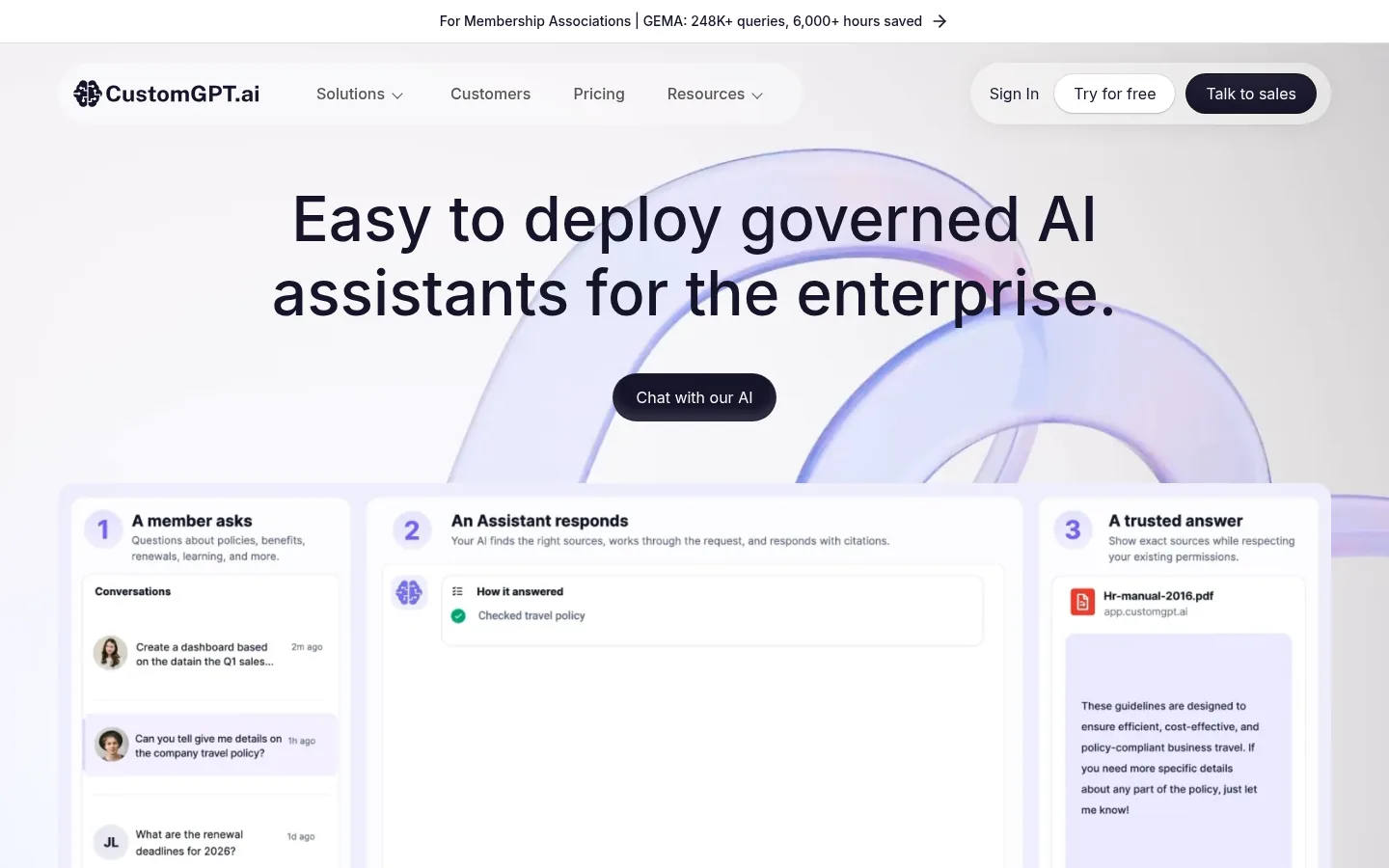
🤖 RAG, citations, and the anti-hallucination design
CustomGPT.ai is retrieval-first. Every answer is generated from the content you index and can carry a clickable citation back to the exact source, so a customer can verify a claim. The anti-hallucination layer is the headline feature: when the knowledge base does not support an answer, the agent declines rather than inventing one, which is how you avoid made-up refund rules or imaginary ETAs. The honest caveat is that this only works as well as the underlying documents; clean, current source material matters more than the model label.
📚 Document capacity, formats, and context depth
Standard holds 60 million words across 5,000 documents per agent and reads 1,400-plus formats, including PDF, Office, audio, and video; Premium expands that to 300 million words and 20,000 documents. Context depth controls how much of the knowledge base each question reads, up to 6,000 tokens on Standard and 12,000 on Premium, with deeper context costing more query credits. For a team with a genuinely large library this is a real advantage over builders that cap storage tightly.
🔗 API, integrations, and the handoff gap
The RAG API is included from the Standard tier, which is unusual at this price and lets a developer build on the retrieval engine directly. WordPress, Wix, Shopify, HubSpot, Zendesk, Google Drive, Notion, and Zapier are all supported, with SharePoint and auto-sync appearing on Premium. The genuine gap is human escalation: there is no native live-agent handoff, so handing a conversation to a person means connecting Zendesk, Intercom, or a similar queue. If your support motion depends on seamless bot-to-human transfer, budget for that integration.
🛡 Security and model choice
Every paid tier lists SOC 2 Type 2, GDPR, and 256-bit AES encryption, with privacy controls and customer data not used for training. Premium adds a PII anonymizer and white-labeling, while Enterprise adds custom SSO, role-based access, a DPA, and the AI model selector. The practical point for a regulated buyer is that the model selector, Azure OpenAI, and Bedrock options are all Enterprise-only, so do not assume the self-serve tiers satisfy a strict compliance review on their own.
What Real Users Actually Say
The two biggest review platforms restrict automated access, so I am separating what I could verify from what is only reported by secondary aggregators.
The Scores I Could Check
Across the aggregators I could access, CustomGPT.ai is reported very positively: G2 is described around 4.8 out of 5 and Capterra around 4.6, with the recurring praise aimed at accuracy, citations, and fast setup. Because individual G2 and Capterra threads disallow automated access and the exact review counts vary across sources, I am not quoting a precise count I cannot ground. Read the high ratings as directionally strong rather than as a settled statistical verdict.
— Accessible review aggregators and secondary roundups; individual G2 and Capterra threads disallow automated access, last checked November 2026
The Recurring Criticism
The praise is consistent: reliable grounded answers, real citations, and a no-code build that non-developers can run. The complaints cluster around cost and structure. First, the $99 entry with 1,000 queries a month is easy to outgrow, and there is no tier between it and the $499 Premium, so buyers face a steep jump with no middle ground. Second, query overage is expensive, and white-labeling and auto-sync are gated above Standard. Third, there is no built-in live handoff, so human escalation needs a third-party tool. There is no evidence of a data-trust crisis; the debate is whether the pricing ladder fits how a team grows.
— Accessible review platforms and aggregator-tagged feedback, November 2026; individual G2 and Capterra threads were not opened directly
Read the split correctly. The strong scores come mainly from teams that value accuracy and got a trusted agent live, and they are not a claim that the entry plan is cheap at scale. Estimate your real monthly query volume and your handoff needs before you commit, rather than judging the product on the 7-day trial.
User feedback sourced from G2 and Capterra reviews.
Pricing: Every Plan, Laid Bare
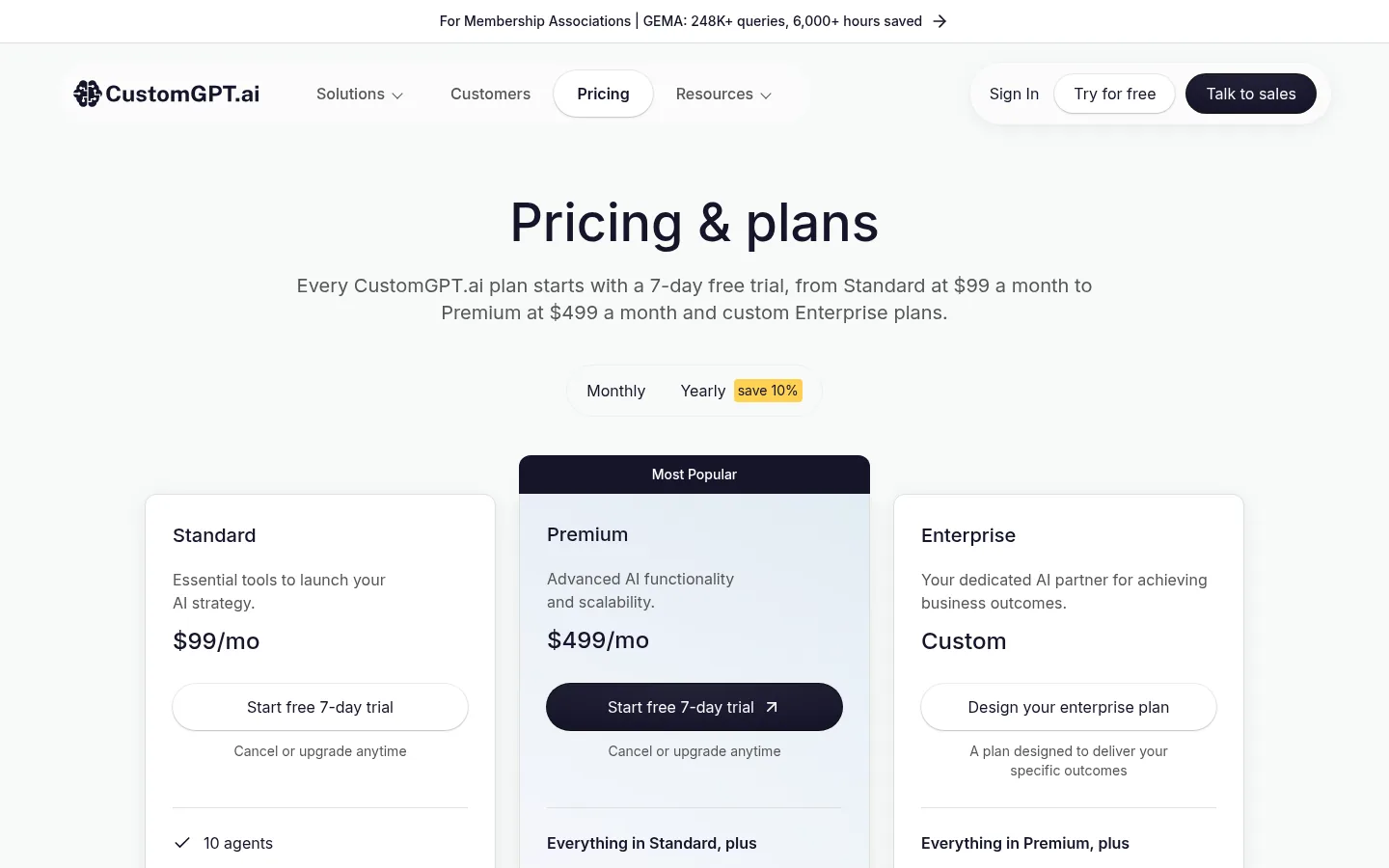
CustomGPT.ai uses query-credit pricing with a 7-day trial on every plan, and yearly billing saves 10%. The figures below are exactly what the live pricing page shows.
| Plan | Price | What You Get |
|---|---|---|
| Standard | $99/mo monthly; $89/mo billed yearly | 10 agents, 1,000 queries/mo, 5,000 documents per agent, 60M words storage, 3 team members, RAG API, citations, 92 languages, 1,400-plus formats. |
| Premium (popular) | $499/mo monthly; $449/mo billed yearly | 25 agents, 5,000 queries/mo, 20,000 documents per agent, 300M words, 5 team members, auto-sync, white-labeling, PII anonymizer, SharePoint. |
| Enterprise | Custom (annual commitment) | Flexible limits, AI model selector, custom SSO, RBAC, DPA, Azure OpenAI and Bedrock, private deployment, dedicated team, call support, white-glove onboarding. |
| Add-ons | 2,500 extra queries $375/mo; 300M extra words $300/mo; 100K extra documents $100/mo; 25 extra agents $100/mo; 5 extra seats $100/mo | Query, storage, document, agent, and seat add-ons available separately. |
The Unfiltered Pros & Cons
Pros
- ✓ Anti-hallucination with clickable citations keeps answers grounded and verifiable
- ✓ Generous document and word storage with 1,400-plus formats and 92 languages
- ✓ RAG API included on the entry plan rather than locked to Enterprise
- ✓ No-code setup with a broad set of integrations and auto-sync on Premium
- ✓ SOC 2, GDPR, and encrypted security posture with no training on customer data
Cons
- ✗ $99 entry with 1,000 queries and no middle tier before the $499 Premium
- ✗ No built-in live-agent handoff; human escalation needs a third-party tool
- ✗ Query overage is expensive, and white-labeling and auto-sync are gated
- ✗ Model selector and Azure/Bedrock options are Enterprise-only
- ✗ Self-serve support is Slack and helpdesk only, with no phone line
Final Verdict
CustomGPT.ai is one of the strongest no-code RAG builders when your priority is trusted, cited answers over a large document library. The anti-hallucination engine, generous storage, and entry-level API are genuine advantages, and the reported user ratings are very high. What keeps it from a higher score is the pricing ladder: a $99 entry with a tight query allowance, a jump straight to $499 with no middle tier, and the lack of native human handoff. Buy it if you need an accurate, well-cited agent and can work around the escalation gap; skip it if you want a low-cost FAQ widget or seamless bot-to-human transfer out of the box.
If you are testing for the first time, use the 7-day trial on real questions and count how many queries a normal week actually generates, because that number decides whether Standard is enough or forces you toward Premium. If you already know you need auto-sync and white-labeling, start on Premium rather than outgrowing Standard immediately.
You can read more about how we test and why you can trust our calls on our methodology page.
Frequently Asked Questions
Is CustomGPT.ai free?
There is no permanent free plan, but every plan starts with a 7-day free trial with full access to that tier’s features. Paid plans start at $99 a month, or $89 when billed yearly.
How do query credits work?
Each chat message uses one query credit, while agentic actions such as lead capture can use more. Standard includes 1,000 queries a month and Premium 5,000. When you hit the limit, agents stop responding to new queries; a query already in progress still finishes.
What is the difference between Standard and Premium?
Premium raises agents from 10 to 25, queries from 1,000 to 5,000, documents from 5,000 to 20,000 per agent, and storage from 60M to 300M words, and adds auto-sync, white-labeling, the PII anonymizer, and SharePoint. There is no tier between the two, so the jump in price is large.
Can the agent hand off to a human?
Not natively. CustomGPT.ai does not include a built-in live-agent queue, so human escalation requires connecting a third-party tool such as Zendesk or Intercom. If seamless handoff is central to your support process, factor that integration into the cost.
About the Author