Before you scroll, a quick orientation: Chatbase is one of the better-known no-code ways to turn your own documents and help-center content into an AI support agent, and it now does more than answer FAQs — it can take guarded actions across your tools and hand off to a human. I worked through the live pricing, the full plan comparison, and the documented feature set below, and I cross-checked what users report on the review aggregators. Every figure here comes from the live site or aggregator-reported ratings, not a vendor deck, so you can decide in one read whether it is worth the trial.
The Short Version
Chatbase started life as a no-code way to train a chatbot on your own documents, and it has grown into a fuller AI-agent platform for support across chat, email, and voice. The current product is built around a single agent per workspace, retrieval over your own sources, plain-language procedures, and AI Actions that can look up an order or change a record in another system, with a helpdesk inbox and escalation sitting underneath. After working through the live pricing page, the full plan-by-plan comparison, the integration and security detail, and what reviewers on the platforms I could access report, I think Chatbase is a strong fit for a small support or e-commerce team that wants retrieval plus real actions in one hosted tool. The catch is the same one that runs through this whole category: it is metered by message credits, and the cheap Hobby plan’s allowance runs out fast once real customers arrive, so the bill moves with your volume rather than staying flat.
Here is what I actually checked. I worked through the live pricing page with the yearly and monthly toggles, every paid tier, the full comparison table, the add-on prices, and the security and compliance section, plus the documentation and use-case pages. I cross-checked ratings against the review aggregators I could access. The builder itself sits behind a signup, so my read of the in-app editor and agent-building flow comes from documented features and reviewer reports rather than a bot I published myself.
The short version: if your team wants an AI agent that answers from your own knowledge and can take guarded actions in Shopify, Stripe, or your help desk, the hosted model is genuinely complete and the helpdesk handoff is real. If you only want a low-cost FAQ box for a quiet site, the credit meter and the per-month pricing will feel like overkill, and a simpler flat-rate tool will be easier to budget.
Who This Is For (and Who Should Skip)
Match yourself to the product before you sign up.
- ✅ Support teams that want retrieval plus actions This is Chatbase’s center of gravity: an agent grounded in your sources that can call AI Actions to look up an order, pull an invoice, or change a record, then escalate to a human when it should not act alone.
- ✅ E-commerce stores on Shopify Shopify is included on every tier, and the agent can retrieve orders and customer context mid-conversation, so it runs a support motion rather than only answering static FAQs.
- ✅ Teams moving toward voice and email support Basic adds voice and a helpdesk inbox, with telephony and outbound campaigns available as you move up, so the same agent can meet customers across channels.
- ❌ Quiet sites that only need a cheap FAQ widget The paid entry plan is metered by message credits, and the free tier carries only a small allowance, so a low-traffic site pays for capacity it barely uses.
- ❌ Buyers who dislike metered billing Costs rise with message volume, and removing Chatbase branding is a separate $99 a month, so teams that scale quickly have to watch the credit meter and add-on charges.
Score Breakdown
What Actually Matters: Features, Reviewed
Rather than recite the marketing page, I focused on the four things that decide whether you buy, skip, or upgrade.
🤖 Retrieval, procedures, and how the agent reasons
Chatbase is a retrieval-plus-instructions agent. You attach sources, choose a model, and write plain-language procedures, calling an AI Action inline wherever the agent needs to look something up or make a change. The playground lets you ask the same question across different models and compare responses before you save, which is the right way to tune it. The honest caveat is that this is only as good as the sources and guardrails you give it; clean, current documentation matters more than the model name on the label.
📥 AI Actions and the helpdesk handoff
What separates Chatbase from a simple FAQ bot is that the agent can act, not just answer: look up an order in Shopify, pull an invoice from Stripe, or find a slot through Calendly in the middle of a conversation. When it hits something it should not handle alone, plain-language rules route it to a human over live chat or a helpdesk ticket, and the Basic tier adds the Chatbase Helpdesk inbox. For a small team this is the practical difference between a bot experiment and a working support desk, and it is the main reason to pick it over a standalone widget.
🎤 Voice, telephony, and multi-channel reach
The agent can be given a voice with adjustable speed and stability, and Basic unlocks voice with telephony and outbound campaigns sitting on higher tiers. Website chat, WhatsApp, Messenger, Instagram, Slack, and WordPress are covered, so a conversation that starts on one channel lands in the same support operation. The practical limit is that voice and telephony are not on the entry plan, so a team that wants phone support should budget for at least Basic rather than Hobby.
🚀 Model choice, API, and security
Chatbase gives you a choice of advanced models from OpenAI, Anthropic, Google, DeepSeek, and others rather than locking you to one provider, and API access opens up from Basic. On the security side it lists SOC 2 Type II, GDPR, and HIPAA eligibility, with data encrypted in transit and at rest and customer data not used to train models. If you operate in a regulated industry, the SSO, audit logs, custom roles, and HIPAA terms you actually need are on Enterprise, so don’t assume the self-serve tiers meet a compliance review on their own.
What Real Users Actually Say
The two biggest review platforms restrict automated access, so I am separating what I could verify from what is only reported by secondary aggregators.
The Scores I Could Check
Across the aggregators I could access, Chatbase is reported positively, with G2 generally described in the high 4-point-something range and Capterra around 4.3, alongside a notably lower Trustpilot score from a much smaller set of reviews. The reported figures and review counts conflict across sources, and at least one aggregator’s current listing status is disputed, so I am not quoting a precise number or count I cannot ground. Read the high ratings as directionally positive rather than as a settled statistical verdict.
— Accessible review aggregators and secondary roundups; individual G2 and Capterra threads disallow automated access, last checked November 2026
The Recurring Criticism
The praise is consistent: fast no-code setup, the ability to train on your own content, and the clean blend of automated answers with human takeover. The complaints cluster around cost and limits. First, message-credit pricing is easy to outgrow, and buyers who expected a flat widget find themselves watching the meter. Second, removing the “Powered by Chatbase” branding costs extra, and additional agents and storage are separate add-ons. Third, some reviewers note that advanced logic and deeper integrations require the higher tiers. There is no evidence of a data-trust crisis; the main debate is whether the metered model fits how a team grows.
— Accessible review platforms and aggregator-tagged feedback, November 2026; individual G2 and Capterra threads were not opened directly
Read the split correctly. The strong scores come mainly from teams that got a support agent live quickly, and they are not a claim that the entry plan is cheap at scale. The recurring warning is about planning: estimate your real monthly message volume and your seat count before you commit, rather than judging the product on the trial.
User feedback sourced from G2 and Capterra reviews.
Pricing: Every Plan, Laid Bare
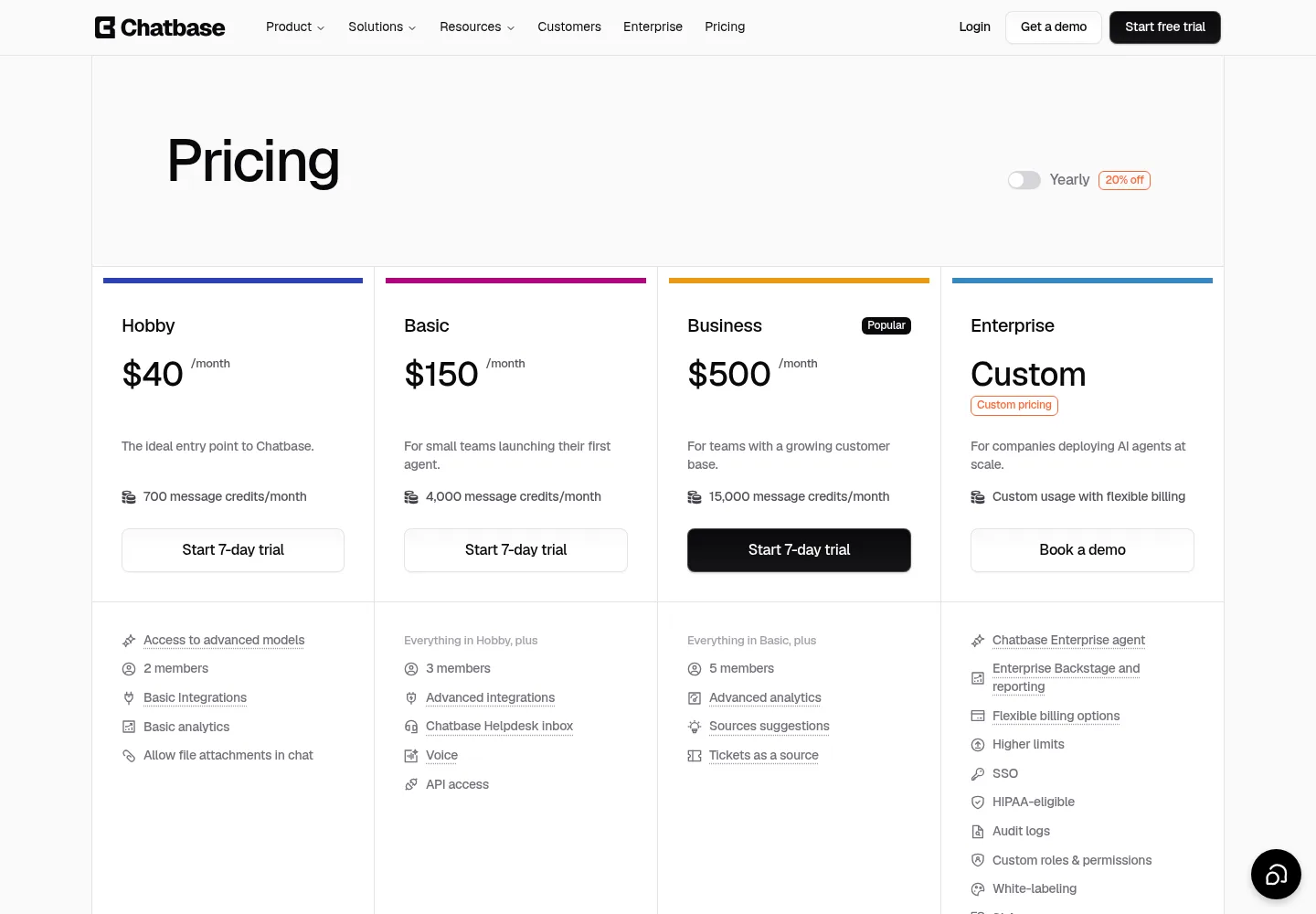
Chatbase uses message-credit pricing with a small free tier, and yearly billing is about 20% cheaper than monthly. The figures below are exactly what the live pricing page shows, with yearly and monthly prices noted.
| Plan | Price | What You Get |
|---|---|---|
| Free | $0 | A single agent with a small monthly message-credit allowance; the exact reported credit figure differs across sources, so treat it as a limited trial rather than a production budget. |
| Hobby | $32/mo billed yearly; $40/mo monthly | 700 message credits, 1 agent, 2 members, 40 MB training content, 5 AI Actions, 2 procedures, attachments, basic analytics, Shopify/Slack/WhatsApp/WordPress/Calendly integrations. |
| Basic | $120/mo billed yearly; $150/mo monthly | 4,000 message credits, 3 members, 8 AI Actions, 4 procedures, advanced integrations, Helpdesk inbox, voice, API access, personalization. |
| Business (popular) | $400/mo billed yearly; $500/mo monthly | 15,000 message credits, 5 members, 12 AI Actions, 6 procedures, advanced analytics, source suggestions, tickets as a source. |
| Enterprise | Custom | Custom usage and flexible billing, SSO, HIPAA eligibility, audit logs, custom roles, white-labeling, SLAs, success manager, and priority support. |
| Add-ons | Auto-recharge $40 per 1,000 credits; remove branding $99/mo; extra agent $25/mo; extra storage $25 per 10 MB/mo | Capacity, white-label, agent, and storage add-ons available separately from billing. |
The Unfiltered Pros & Cons
Pros
- ✓ Retrieval plus AI Actions and procedures in one hosted agent
- ✓ Helpdesk inbox and clean human escalation turn it into a real support desk
- ✓ Choice of major models rather than lock-in to one provider
- ✓ Fast no-code setup with multi-channel reach and API access from Basic
- ✓ SOC 2, GDPR, and HIPAA-eligible security posture with customer data not used for training
Cons
- ✗ Message-credit pricing is easy to outgrow as volume rises
- ✗ Removing Chatbase branding costs $99 a month, and extra agents and storage are separate
- ✗ Voice, telephony, helpdesk, and API are gated to Basic and above
- ✗ Exact aggregator ratings and counts cannot be independently verified
- ✗ Self-serve support is chat and email only, with no phone line
Final Verdict
Chatbase is a genuinely complete hosted AI agent, and it is most compelling when you use the actions, helpdesk, and multi-channel features rather than treating it as a cheap FAQ box. The model choice and retrieval engine are strong, and the human handoff keeps automated and live support in one operation. What keeps it from a higher score is the message-credit meter that climbs with volume, the separately charged branding and agents, and the way the support and voice features are gated above the entry plan. Buy it if you want a support agent that can both answer and act on your own systems; skip it if you only need a low-cost, flat widget for a quiet site.
If you are testing for the first time, use the free tier and trial on real customer questions, then count how many messages a normal week actually generates. That number tells you whether Hobby is enough or whether the helpdesk and voice needs put you on Basic. If you already know you need the inbox and API, start with Basic rather than outgrowing Hobby in the first month.
You can read more about how we test and why you can trust our calls on our methodology page.
Frequently Asked Questions
Is Chatbase free?
There is a free tier with a single agent and a small monthly message-credit allowance. The exact free credit figure differs across sources, so treat it as a limited way to test the product. Paid plans start at $32 a month billed yearly, or $40 monthly.
How do message credits work?
Each agent response consumes message credits, and some advanced models cost more credits per response. Credits renew monthly with your plan, and you can enable auto-recharge at $40 per 1,000 additional credits so an agent does not stop when you run out.
What is the difference between Hobby and Basic?
Basic raises the allowance from 700 to 4,000 credits and adds the Helpdesk inbox, voice, API access, advanced integrations, and more members and AI Actions. Hobby is built for a single agent entry point; Basic is the first plan that works as a full support platform.
Can Chatbase take actions in my other tools?
Yes. Through AI Actions and procedures the agent can look up records or make changes in connected systems such as Shopify, Stripe, and Calendly, with API access from Basic for custom connections. Humans keep approval and escalation control through the helpdesk rules.
About the Author